> ## Documentation Index
> Fetch the complete documentation index at: https://docs.magic-resume.cn/llms.txt
> Use this file to discover all available pages before exploring further.
# Resume schema
> The Zod-typed source of truth for what a resume is.
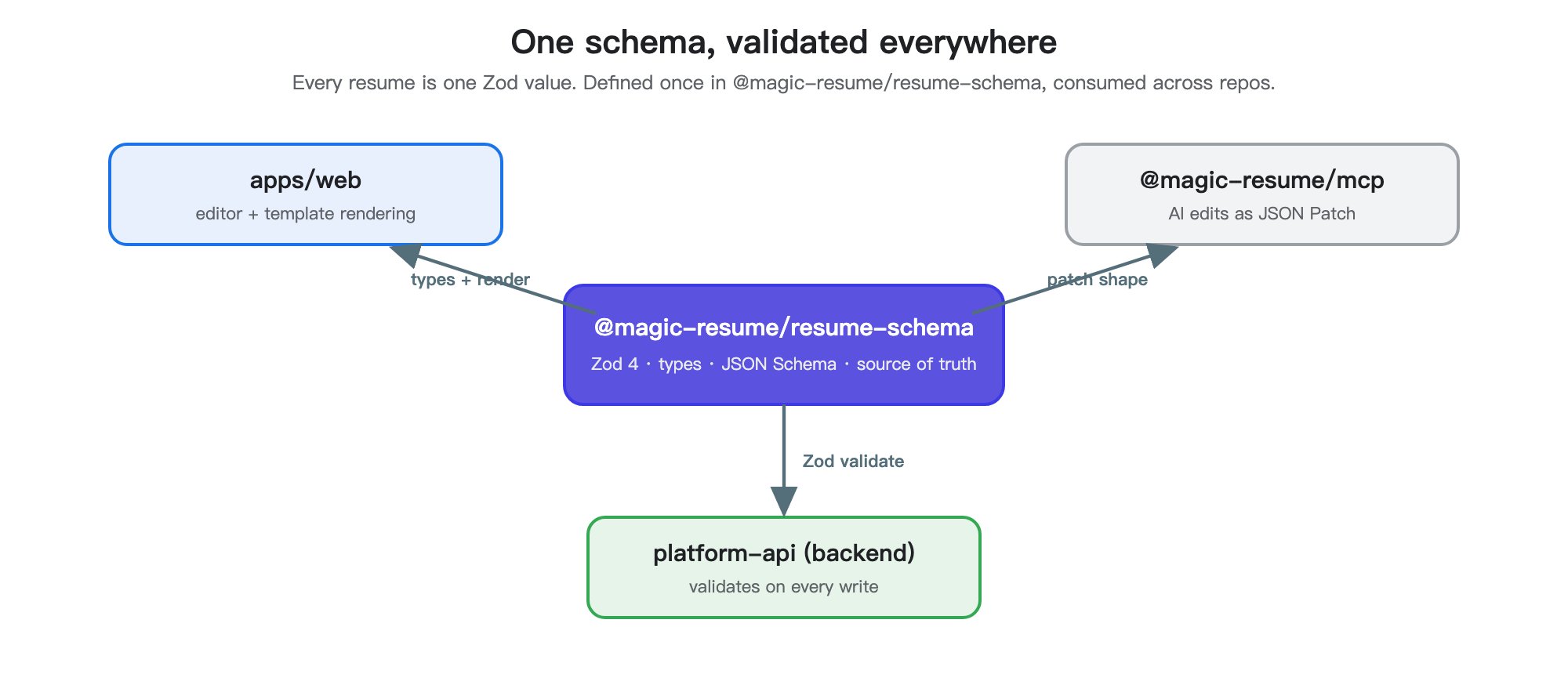
`@magic-resume/resume-schema` is the single source of truth for the resume data shape. The web app, the MCP server, every template, and every AI tool all conform to it. If a field isn't in the schema, it doesn't exist.
 ## Exports
```ts theme={null}
import {
resumeSchema, // Zod schema (validate at runtime)
type Resume, // inferred TS type
defaultResume, // blank resume with required fields
sampleResume, // populated example for screenshots / tests
templateIds, // readonly tuple of valid template IDs
templateSchema, // Zod enum derived from templateIds
resumeJsonSchema, // JSON Schema (used by MCP resources)
} from '@magic-resume/resume-schema'
```
All sub-schemas (`basicsSchema`, `experienceSchema`, etc.) are also exported individually so callers can validate one section in isolation.
## Build output
The build step does **two** things:
1. `tsc` produces `dist/` with type declarations.
2. `scripts/write-schema.mjs` emits `dist/schema.json` — a static JSON Schema artifact.
`dist/schema.json` is what the MCP server serves as a resource, so AI tools can introspect the resume shape without a runtime call.
## Patch flow
Mutations are JSON Patch (RFC 6902) operations. The roundtrip:
```
client patch ──▶ resumeSchema.safeParse(applyPatch(current, ops))
│
▼
ok? ──▶ commit to store / write to API
no ──▶ reject the patch, return validation error
```
This applies to **both** the web editor and MCP tools — the editor produces patches too, it's not a separate code path.
The MCP server has `preview_resume_patch` for exactly this validation loop without mutating state. Use it from AI tools before applying anything destructive.
## Adding a new field
1. Add it to the right sub-schema in `packages/resume-schema/src/`.
2. Update `defaultResume` and `sampleResume` if it's required.
3. Rebuild: `pnpm --filter @magic-resume/resume-schema build`.
4. Update consuming templates in `packages/resume-templates` and the editor form in `apps/web/src/components/editor/`.
5. If the field affects AI editing, add guidance to `get_resume_editing_guide` in `packages/mcp/src/resume-tools.ts`.
## Adding a new template ID
Template IDs are part of the schema (`templateSchema` is a Zod enum over `templateIds`). When you add a new one, three things must stay in lockstep:
1. `templateIds` in `packages/resume-schema`
2. `templateRegistry` in `packages/resume-templates/src/registry.ts`
3. A thumbnail at `apps/web/public/templates/jpg/{id}.jpg`
Missing any of these causes a runtime error somewhere downstream — the editor will offer a template that doesn't render, or the schema will reject a valid resume.
## Exports
```ts theme={null}
import {
resumeSchema, // Zod schema (validate at runtime)
type Resume, // inferred TS type
defaultResume, // blank resume with required fields
sampleResume, // populated example for screenshots / tests
templateIds, // readonly tuple of valid template IDs
templateSchema, // Zod enum derived from templateIds
resumeJsonSchema, // JSON Schema (used by MCP resources)
} from '@magic-resume/resume-schema'
```
All sub-schemas (`basicsSchema`, `experienceSchema`, etc.) are also exported individually so callers can validate one section in isolation.
## Build output
The build step does **two** things:
1. `tsc` produces `dist/` with type declarations.
2. `scripts/write-schema.mjs` emits `dist/schema.json` — a static JSON Schema artifact.
`dist/schema.json` is what the MCP server serves as a resource, so AI tools can introspect the resume shape without a runtime call.
## Patch flow
Mutations are JSON Patch (RFC 6902) operations. The roundtrip:
```
client patch ──▶ resumeSchema.safeParse(applyPatch(current, ops))
│
▼
ok? ──▶ commit to store / write to API
no ──▶ reject the patch, return validation error
```
This applies to **both** the web editor and MCP tools — the editor produces patches too, it's not a separate code path.
The MCP server has `preview_resume_patch` for exactly this validation loop without mutating state. Use it from AI tools before applying anything destructive.
## Adding a new field
1. Add it to the right sub-schema in `packages/resume-schema/src/`.
2. Update `defaultResume` and `sampleResume` if it's required.
3. Rebuild: `pnpm --filter @magic-resume/resume-schema build`.
4. Update consuming templates in `packages/resume-templates` and the editor form in `apps/web/src/components/editor/`.
5. If the field affects AI editing, add guidance to `get_resume_editing_guide` in `packages/mcp/src/resume-tools.ts`.
## Adding a new template ID
Template IDs are part of the schema (`templateSchema` is a Zod enum over `templateIds`). When you add a new one, three things must stay in lockstep:
1. `templateIds` in `packages/resume-schema`
2. `templateRegistry` in `packages/resume-templates/src/registry.ts`
3. A thumbnail at `apps/web/public/templates/jpg/{id}.jpg`
Missing any of these causes a runtime error somewhere downstream — the editor will offer a template that doesn't render, or the schema will reject a valid resume.